Report Shows Sediment Quality in Bellingham Bay Is Declining
The tiny critters living in the mud at the bottom of Bellingham Bay are showing signs of stress, according to a recently released report by the Washington Department of Ecology.
A bay-wide survey found that the abundance and diversity of sediment-dwelling (benthic) invertebrates like clams, snails, sea stars, crabs and shrimp are unusually low.
“This is a strong indicator that the sediment quality in the bay is declining,” said Valerie Partridge, Ecology’s lead author for the report.
An intensive survey in 2010 sampled the top inch of sediment at 30 locations across the bay. Scientists measured the levels of chemicals, toxicity, and invertebrate abundance and diversity. The results were compared against past surveys from 2006 and 1997, as well as results for the rest of Puget Sound.
While scientists found a large number of marine organisms in each of the samples, the diversity was very low. One group of marine worms, which can survive and even thrive in harsh conditions and are considered stress-tolerant, was overly abundant in the samples. And the types of marine life that are most sensitive were rare or absent.
Several invertebrates that are resilient to harsh conditions made up a high percentage of the total abundance in Bellingham Bay.
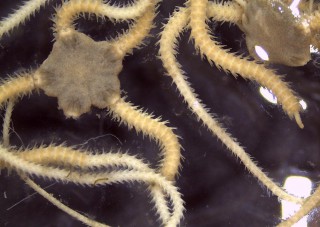
Clams, snails, crabs, shrimp and brittle stars, which are susceptible to harm from harsh conditions, were found in unusually low numbers. “Their numbers were noticeably lower this time, which tells us the benthic community isn’t healthy,” said Partridge. “They were more abundant in the past surveys.”
Another strong indicator of declining sediment quality in the bay was the prevalence of sediments that were toxic in laboratory tests. “About two-thirds of the samples from Bellingham Bay had some degree of toxicity,” said Partridge.
Ecology has documented a trend in declining sediment quality across Puget Sound and the Strait of Georgia, but the quality in Bellingham Bay was lower than both.
The decline could not be attributed to any significant chemical contamination that Ecology measured. Scientists believe that other environmental conditions are impacting the benthic communities.
Some of the factors that may influence the health of organisms at the bottom of Bellingham Bay include:
- Changes in food resources that sink through the water and reach the sediments.
- Changes in dissolved oxygen, pH, and levels of ammonia and sulfides in the water above and within the sediments.
- Natural population cycles of sediment-dwelling organisms that may be influenced by oceanic cycles.
- Sediment movement and burial.
- Unmeasured contaminants, including contaminants of emerging concern, contaminant mixtures, and contaminants that may sicken but not kill marine life.
Ecology’s sediment monitoring program was established to measure levels of toxic chemicals throughout Puget Sound, and to determine their effects on benthic invertebrate communities.
The study is part of the Puget Sound Ecosystem Monitoring Program, a collaboration of state, federal, tribal and local government agencies, non-governmental organizations, watershed groups, business, academic researchers, local integrating organizations, and other private and volunteer groups and organizations – all dedicated to monitoring environmental conditions in Puget Sound.
Press Release, January 09, 2014; Image: Flickr