Scientists Discover New Deep-Sea Vents in Mariana Back-Arc
 Photograph of the seafloor showing the edge of a recently erupted lava flow, Photo: SOI/AUV Sentry
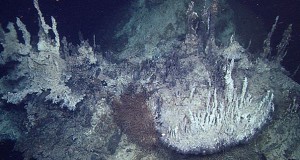
A team of scientists on a 28-day expedition onboard R/V Falkor have more than doubled the number of known hydrothermal vent sites in the Mariana Back-arc region. Several momentous findings were made, including the discovery of one of the deepest vents ever found.
According to Schmidt Ocean Institute, another important outcome was the discovery of a rare recently-erupted underwater lava field that is likely only a few months old. “This region probably experiences eruptions no more than once a century,” said Chief Scientist Dr. Joseph Resing. The scientists also observed cloudy warm water leaking through the still-cooling pillow lavas. “When AUV Sentry came back on board and we looked at the photo survey our jaws just dropped,” Co-Chief Scientist Bill Chadwick explained. “There was this brand new lava flow on the sea floor, which looks like it could have come out yesterday, and that was totally a surprise. It’s in a fascinating part of the Back-arc with whopping hydrothermal signals.”
The team on R/V Falkor led by NOAA Pacific Marine Environmental Laboratory Cooperative Institute scientists Dr. Joe Resing from University of Washington and Dr. Bill Chadwick from Oregon State University, were able to increase the number of known hydrothermal vent sites in the Back-arc from three to seven by discovering four new areas of activity.
The group used their Woods Hole Oceanographic Institution’s Autonomous Underwater Vehicle (AUV) Sentry, operated as part of the National Deep Submergence Facility. Multibeam sonar and chemical and optical sensors were also used to hunt for the new hydrothermal oases on a track that explored a 600-km (400 mile) stretch of Pacific seafloor in the vicinity of the Marianas Trench Marine National Monument.
The science team will return to the same Back-arc region one year from now to explore the newly-found hydrothermal vents with Schmidt Ocean Institute’s new 4,500 m Remotely Operated Vehicle (ROV).
All data obtained during the expedition are made publicly available by Schmidt Ocean Institute. Support for this expedition was provided by the NOAA Ocean Exploration and Research Program and NOAA’s Pacific Island Regional Office, Schmidt Ocean Institute wrote.