Deepwater Horizon Oil Spill Left Permanent Traces on Gulf Marshes, Study Shows
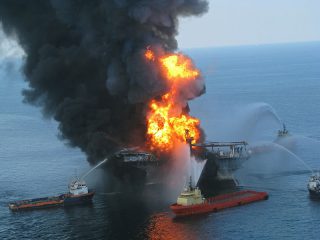
The Deepwater Horizon oil spill six years ago caused widespread marsh erosion that may be permanent in some places, according to a new Duke University-led analysis of 270 miles of the Louisiana, Mississippi and Alabama coasts.
At the hardest-hit of 103 Natural Resource Damage Assessment (NRDA) sites, where oil covered more than 90 percent of plants’ stems, widespread die-off of grasses at the marsh edge occurred, followed by up to two years of accelerated erosion as dying plant roots lost their grip on marsh soil.
Erosion rates at these heavily oiled sites were between 1.4 and 1.6 meters per year higher than scientists had expected, based on findings from similar areas that weren’t hit with oil, Duke University wrote.
The April 20, 2010 explosion on the Deepwater Horizon offshore oil rig killed 11 workers and pumped more than 100 million gallons of crude oil into the northern Gulf of Mexico, making it the worst environmental disaster of its kind in U.S. history.
“Marshes that experienced elevated erosion due to high levels of oiling didn’t recover; they’re now gone, having been converted to mudflats in the shallow underwater environment of the Gulf,” said Brian R. Silliman, Rachel Carson associate professor of marine conservation biology at Duke’s Nicholas School of the Environment, who led the new large-scale analysis.
The outlook is more optimistic for marshes where oil covered less than 90 percent of plant stems.
“In these marshes, erosion rates did not accelerate, likely reflecting less oil impact,” Silliman said. “So long as the marsh platform elevation is sufficient and the rooting system of the vegetation is healthy and intact, these marshes could potentially recover over time.”
The team’s research, published in the journal Nature Scientific Reports, used data collected as part of the NRDA, which was conducted by state and federal Natural Resource Trustees in the aftermath of the Deepwater Horizon spill.
Various sources have estimated that between 60 and 100 linear kilometers of salt marsh experienced plant stem oiling above the 90 percent threshold because of the Deepwater Horizon spill.
“Our analysis reveals that accelerated erosion, and likely land loss, occurred in these areas,” Silliman said.
Most of the erosion occurred within one to two years after the spill, he noted.
The new findings corroborate an earlier study led by Silliman that showed elevated erosion at a limited number of heavily oiled sites. They also support studies led by Mark Hester and Jonathan Willis at the University of Louisiana’s Institute for Coastal and Water Research, which found that there was widespread die-back of marsh plants at these sites.
“Given the vital roles coastal salt marshes play in protecting shorelines from erosion and flooding, providing habitat for wildlife and helping clean our water, scientists need to understand the thresholds of salt marsh resilience to human disturbances like oil,” Silliman said. “By identifying the 90 percent threshold above which spill-induced erosion occurs, our study provides key knowledge to more accurately predict loss of marsh ecosystems following future spills.”
The study was conducted by scientists at Duke; Iowa State University; the University of California-Santa Cruz; the University of Louisiana at Lafayette; Abt Associates of Boulder, Colo.; and the Instituto de Investigaciones Marinas y Costeras of Mar del Plata, Argentina with funding from the State of Louisiana, the National Oceanic and Atmospheric Administration, British Petroleum, the National Science Foundation, the Stolarz Foundation, and the Gulf of Mexico Research Initiative.