Companies Team Up to Build Optical Subsea Cable Between Asia and US
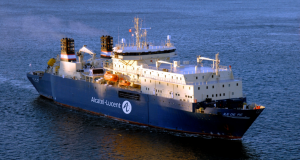
 TE SubCom will deploy this new submarine cable system. Photo: TE Connectivity
A consortium comprising of NTT Communications, SoftBank, Facebook, Amazon, PLDT and PCCW Global, has signed an agreement to participate in the construction and maintenance of the JUPITER optical submarine cable between Asia and the United States.
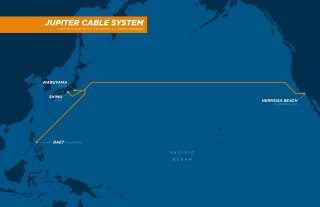
The JUPITER cable system will have a total length of 14,000 kilometers connecting Japan, the U.S. and the Philippines, and an initial design capacity of 60Tbps.
It will have two landing points in Japan—the Shima Landing Station in Mie Prefecture and the Maruyama Landing Station in Chiba Prefecture—as well as a U.S. landing station in Los Angeles, California and the Daet Cable Landing Station in the Philippines.
NTT Com’s Asia Submarine-cable Express (ASE), Asia Pacific Gateway (APG) and Pacific Crossing-1 (PC-1) cables will connect with JUPITER to provide a three-route structure linking major cities in Asia, Japan and United States with a secure and reliable international network.
JUPITER will feature a submersible ROADM (reconfigurable optical add-drop multiplexer) employing WSS (wavelength selective switch) for a gridless and flexible bandwidth configuration.
TE SubCom, a TE Connectivity company has also informed that the supply contract for the JUPITER subsea cable system has come into force.
“TE SubCom has been deploying progressively more advanced optical add/drop multiplexing technology in various undersea applications since 2009,” said Mark Enright, VP customer solutions, TE SubCom. “The ROADM nodes in the JUPITER design are our most advanced form of this technology to date, providing unprecedented bandwidth reconfiguration flexibility in an undersea network. As the supplier of the most undersea OADM nodes in the world, with an impeccable track record, we are in a unique position to bring this advanced technology to the JUPITER Cable system.”
JUPITER is expected to launch in early 2020 with an initial design capacity of 60Tbps, which will be expanded later to meet rising data demands and complement existing cable systems.
“The demand for bandwidth in the Pacific region continues to grow at a remarkable rate, and is accompanied by the rise of capacity-dependent applications like live video, augmented and virtual reality, and 4k/8k video,” said Koji Ishii of SoftBank, co-chairperson of JUPITER consortium. “JUPITER will provide the necessary diversity of connections and the highest capacity available to meet the needs of the evolving marketplace. TE SubCom has a proven record of success in the design and implementation of innovative, scalable and robust transoceanic cable systems, making the company the most reliable choice for the JUPITER supply partner.”