Seaborn Networks Provides Direct Route Between Brazil and United States
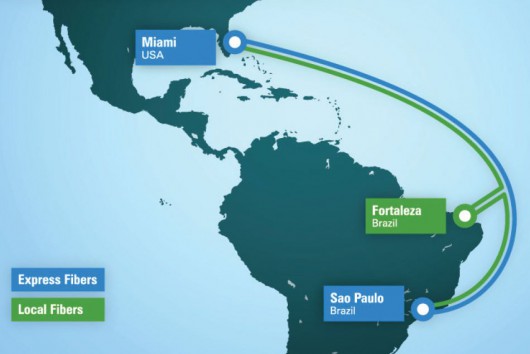
Seaborn Networks announced that, in response to significant customer demand, its Seabras-‐1 submarine cable will now provide the first-‐ever direct route between the commercial and financial centers of Brazil and the United States.
Seabras-‐1’s new landing in the New York metropolitan area will connect directly to the landing in Sao Paulo.
Seabras-‐1 will continue to have a branching unit that lands in Fortaleza, Brazil. Seaborn Networks will provide capacity on a POP to POP basis, and also plans to continue to make available a route from all three of its landings to the NAP of the Americas and other POPs in Miami.
The direct Sao Paulo – New York route offers numerous advantages:
· Lower latency between the financial and commercial centers of Brazil and the United States. Latency for the New York – Sao Paulo route is engineered at 104ms for POP to POP service.
· Shorter distance to most of the Mid-Atlantic region in the US. Virginia, Maryland, North Carolina, and Washington, D.C. are closer to New York metropolitan area than to Miami.
· Lower costs for customers. By bundling backhaul into major POP locations, Seabras-‐1 will provide improved access to onward connectivity to key IP hubs, data centers and points of presence throughout North America.
· Easy onward connectivity to rest of world. The New York metropolitan area is an international gateway to Europe, the Middle East and Africa via trans-‐Atlantic cables, and enables high speed routes to the West coast of the US to connect to Asia via trans-‐Pacific cables.
· More reliable network architecture than existing US – Brazil systems. With no interim landings on the subsea route, Seabras-‐1 will maintain a lower number of active system elements, thereby reducing the probability of system failure. Competing systems have more than 2.3X the number of active elements in delivering a single wavelength service.
· Improved route diversity with no dependencies on hurricane-prone Florida. With the majority of other cables landing in Florida, Seabras-‐1 offers a compelling alternative route or protection route.
“The decision to land in the New York metropolitan area instead of Miami is in response to significant customer demand,” said Larry Schwartz, Seaborn Networks’ Chief Executive Officer. “By offering improvements to latency, onward connectivity and reliability, Seabras-‐ 1 is a compelling choice for carriers, content providers, governments and others that value a direct, low latency route between the commercial and financial centers of Brazil and the United States.”
Press Release, July 30, 2012