Electro Standards Laboratories Develop New Conversion Systems (USA)
Electro Standards Laboratories, Cranston, RI, has collaborated with the University of Rhode Island, Kingston, RI, in the development of two new wave energy conversion systems to power remote sensor buoys. The green energy accomplishments include a Direct Drive System and a Resonant Drive System.
The Direct Drive System developed by Electro Standards Laboratories and the University of Rhode Island team employs small electric generators that are directly driven via a surface buoy’s wave-induced heave motion. This system provides power from the differential motion between the buoy float and a submerged resistant plate. This configuration provides reliable operation without the need for additional gearing and has the ability to harness electrical power in the 1 to 10 Watt range in small sea states (WMO Sea State 1: Calm). The buoy response in the Direct Drive System is designed to match a wide range of expected ocean wave spectra based on the deployment location. Direct Drive of the system with wave motion results in broad band response with high efficiency. Other benefits of this system include low acoustic noise and stealthy operation.
The Resonant Drive System developed by the collaboration of Electro Standards Laboratories and the University of Rhode Island employs small electric generators that are resonantly driven via a surface buoy’s wave-induced heave motion. This system amplifies the generator’s armature motion at the peak period of the sea state (WMO Sea State 1: Calm). The buoy response in the Resonant Drive System is designed to match the expected ocean wave spectrum based on the deployment location. The benefits of the resonant system include enhanced functionality, higher performance and continuous operation. The buoy is completely sealed with no external moving parts.
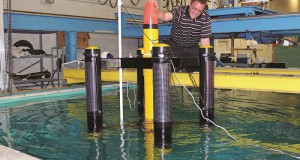
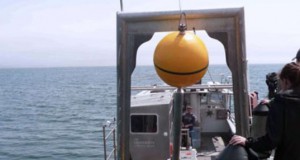
Scale model testing of the Direct Drive and Resonant Drive Systems has been performed in the University of Rhode Island Department of Ocean Engineering wave tank as well as at the mouth of Rhode Island’s Narragansett Bay. Electro Standards Laboratories’ model simulations have shown good agreement with the scale model tests. This small buoy sensor system generates and accumulates energy that can be used to indefinitely power remote buoys equipped with sensor arrays as well as electronics for processing and communications. This power source can be used to minimize the size of batteries or to eliminate the need for batteries if supercapacitors are used. The buoy system design is customized and scalable (1-250 W) and can be suited to moored or drifting applications.
Electro Standards Laboratories provides state-of-the-art research and applied experience in AC, DC and SRM electric motor controls, estimation, and power electronics. These include mechanically sensorless motor control, hybrid electric vehicles, low noise motor control, and linear motor aircraft launch and arrest systems.
Press Release, December 24, 2012