Eni Norge Tests Underwater Robot in Hammerfest
A new robot designed to carry out subsea environmental monitoring along predetermined tracks is now being tested by Eni Norge. Eni Norge is investing heavily in research and development linked to new and improved techniques for monitoring the marine environment.
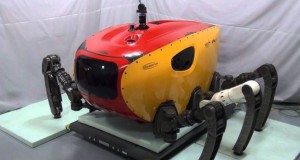
Together with its subsidiary Tecnomare, Eni Norge has completed the research and development project “CleanSea”. One of the project’s aims has been to develop a so-called Autonomous Underwater Vehicle (AUV) – a robot which can travel independently under water along predetermined tracks, carrying out sampling which is important as part of monitoring the marine environment.
“In contrast to traditional AUVs, this robot is equipped with multiple propellers”, says Arild Jenssen, Subsea Engineer at Eni Norge. “These enable it to stop, hold its position and adjust its movements as required and in response to sensor data”, he says. “A further benefit is that we can control the robot without the aid of cables extending from land or a surface vessel. It is pre-programmed and simply carries out the job it is asked to do“, says Jenssen.
Hammerfest test
The robot is equipped with a high resolution video camera and lights, a methane sensor, a leakage detection hydrophone, and a fluorescence sensor to detect hydrocarbons and trace substances. It will also map the sea floor and take water samples. It is the last of these functions that was tested in Hammerfest harbour.
“As operator for Goliat, the first oil field to come on stream in the Barents Sea, Eni Norge aims to be in the forefront of technological development”, says Jenssen. “There are very few off-the-shelf products used in the Goliat project. Most systems are tailor-made”, he says. We shall be innovative in all aspects of our activities. It is important to test the AUV under field conditions and Hammerfest is the natural choice”, he says.
New ideas
Eni Norge is also working on a technology which utilises subsea systems controlled from land without support offshore. Our aim is to expand the existing network used by remotely-operated oil and gas wells with the help of an optical network which transmits data at high speeds using light. This will make it possible to receive live images and data, provided that the vehicle is within range of a transmitter. “At the moment this technology is at an early experimental stage, but it will open the door for future autonomous robots able to carry out maintenance on remotely-controlled fields”, says Jenssen.
About the AUV
The AUV is supplied by Saab Seaeye in Sweden, which develops a great deal of equipment for naval and oil industry applications. It is 3.8 metres long, 1.4 metres wide and weighs 1300 kilograms. It is capable of working at depths of up to 3000 metres and has a top speed of 4 knots.
Press Release, October 29, 2013; Image: Eni