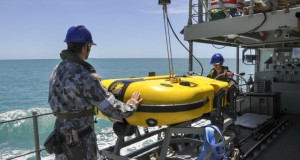
Royal Navy’s MASTT Starts Minehunter Testing

Royal Navy’s specialist team of sailors is currently testing the motorboat called Hazard in Portsmouth Naval Base. It can act as the ‘mother ship’ to an assortment of hi-tech remote-controlled and robot submersibles.
Collectively, they can search, hunt and finally destroy mines faster then the Royal Navy’s Sandown and Hunt-class ships, and have the added benefit of keeping the handful of sailors required to operate them out of harm’s way.
Modified versions of the same systems are also being looked at to carry out survey operations such as those performed by HMS Echo, currently looking for the missing Malaysian airliner, as part of the future Mine Counter Measures and Hydrographic Capability programme.
The Maritime Autonomous System Trials Team (MASTT) is the small Portsmouth-based Royal Navy unit testing the new unmanned systems.
Chief Petty Officer Colin Dumbleton, who has spent more than 20 years in the mine warfare branch, said: “It’s great that the Navy is taking a step in the right direction, looking at the technology out there, and seeing where we can use it in the future.”
The family of equipment MASTT is putting through its paces is headed by Hazard, a small, fast motor launch, capable of speeds up to 30kts and able to be transported by an RAF Hercules.
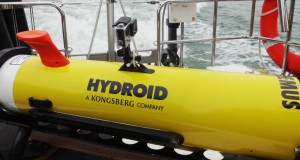
The boat carries either the bright yellow torpedo-sized Remus 600 or the much smaller Remus 100, which are sent off to scan the seabed at depths of up to 600 or 100 metres respectively.
After several hours in the water scanning the ocean floor, the submersibles return to their mother ships and the data is then collected downloaded and analysed by the Royal Navy’s mine warfare experts.

They can then send in another small submersible, steered on to a contact and identified by a mine specialist using its onboard camera. On the front line it would carry an explosive charge to destroy any mines, like the Seafox system used by Royal Navy minehunters off Libya and in the Gulf.
The immediate goal for the team is to fit this technology and unmanned sweep systems to a Hunt-class ship, but in the future the system could easily be run from any reasonable-sized warship, and sent anywhere in the world in just 48 hours.
They will sit safely on the ship, or in a base ashore, and send unmanned surface vessels and their remote systems off hunting mines or gathering hydrographic data.
“The technology is proven, we’re taking it into the military realm. This will be the seafaring equivalent of the unmanned aircraft which have revolutionised aerial warfare,” said Lieutenant Commander Jack McWilliams, Officer in Command of MASTT.
“It takes the sailor out of the minefield, but we are not taking them out of the equation. You will still need individuals with specialist mine warfare and hydrographic skills, a human being to identify a contact, but they will be much safer, and this is a much more effective way of doing our job. This technology is fantastic, and we are right at the forefront of it. It is the future.”