Russian Divers Achieve Record Antarctic Plunge
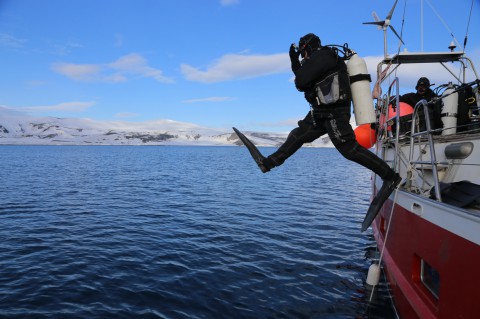
On December 24, 2014 the Antarctica 100 expedition of the Russian Geographical Society’s Branch in the Republic of Tatarstan returned from the Antarctic.
Russian divers led by Dimitri Schiller went to the South Pole. The project’s objective was to develop relatively safe methods of deep diving in the Antarctic conditions to improve the effectiveness of underwater exploration. In addition, the team was testing Russian diving equipment.
Antarctica 100 is the third stage of a large-scale research project called “Cold Pole” conducted by Tatarstan branch of the Russian Geographical Society and the Federation of Underwater Sports of Russia.
Due to a number of factors diving in the waters of the Antarctic belongs to the category of baffling complexity. Among such factors are: cold water (2 C degrees below 0), strong streams, icebergs which can collapse any moment even because of air bubbles exhaled by a diver, strong waves, etc. In case of emergency it is difficult to provide any medical help because of the remoteness.
Dives to a depth of less than 20 meters are considered relatively safe. In scientific purposes experts dive up to 65 meters risking their lives. But works at greater depths are carried out with the help of a variety of remotely operated equipment.
On the 5th of December, 2014 at 11 am Moscow time, Antarctica-100 put out to sea from the Argentine port of Ushuaia on an ice-class yacht and headed for the South Shetland Islands.
On December 10 Dmitry Schiller dived in the Antarctic waters near Deception Island, a ring-shaped caldera of a struck volcano. The maximum depth of his dive was 97 meters.

Right after the members of the expedition returned to Moscow they held a press conference at the Headquarters of the Russian Geographical Society in Moscow and told the journalists about their travel.
“To begin with, passing the Drake Passage on a 16-meter ice class sailing yacht was not the most pleasant event in our lives”, says Schiller. “Almost all the time the yacht literally went at an angle of 35-40°. 24 hours a day. The team kept ice watches tracking ice blocks in the sea and dodging them. It was always snowy or rainy.”
“The weather gave us only one eight-hour window near the island of Deception. It was enough to carry out one dive. Or two rather: one deep dive to the depth of 97 meters and one to the depth of 45 meters.
“So without any estimations we started working. We planed to dive to the depth of 100 meters. However, the depth was only 97 meters. We reached the bottom.
“In short, it was very hard. Perhaps it was my most difficult mission for the last five years,” Schiller concluded.
The Antarctica 100 expedition had different goals: the object of the study was not the waters of Antarctica or Hydrobiology of the oceans surrounding Antarctica, but themselves. Their goal was to develop deep-sea diving techniques using conventional equipment in extreme conditions.
10 people participated in the expedition. The youngest participant is 18-year-old Valery Saleev, the oldest participant is 48-year-old Andrei Filippov.