Osiris Launches d’ROP Survey Platform
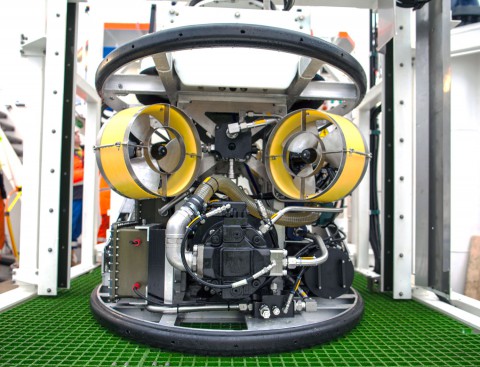
Osiris Projects has introduces its new survey platform known as d’ROP.
The company believes that the innovative d’ROP system has the potential to revolutionise productivity in shallow water survey and inspection applications.
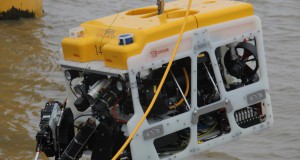
d’ROP is a dynamic Remotely Operated Survey Platform that borrows and combines technology and operating principles from existing ROVs’, ROTVs and systems from the modern day dredging industry.
Addressing many of the inherent limitations of compact free-flying ROVs and seabed crawler systems, the d’ROP is suited for precision tracking operations in dynamic coastal environments.
Osiris Projects Managing Director, Andy McLeay, explains: “The system is effectively a compact high powered work class ROV platform but with all the expensive and complicated bits that we don’t need for our survey tasks stripped off; no vertical thrusters, simplified ‘hands-off’ deployment and close to fully automated operation.”
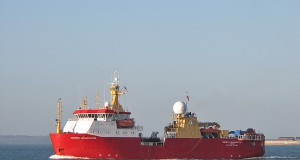
The d’ROP is designed initially for operation from the company’s newly launched survey vessel Bibby Athena, the sister ship to the successful Bibby Tethra launched in 2011. Deployed vertically through the vessel’s moonpool, the system relies upon the support vessel for forward propulsion, a bespoke heave-compensated umbilical winch and combined LARS for its vertical control with the on-board thrusters maintaining heading and fine adjustments to the lateral position.
According to Osiris Projects, maintaining a fixed heading and altitude in relation to a survey line, cable or pipeline, this provides exceptional line-keeping ability in comparison to traditional mid-size ROV systems without additional power requirements. Providing significantly more thrust than an equivalent-sized ROV, the d’ROP’s ability to hold station allows it to remain stationary, operate at slow speed for depth of burial surveying, or track at up to 4 knots for acoustic survey.
Whilst the system was designed primarily for precision-tracking of buried cables and pipelines in coastal environments, the d’ROP can accept multiple sensors simultaneously. Data is transmitted through a fibre-optic connection for quick, reliable transfer. The system also has the ability to convert into a seabed crawler in suitable seabed conditions.
Andy McLeay continues: “The beauty of this system is that it is assembled from proven components and has the flexibility to support virtually any survey sensor. It can be considered as an extension of the survey vessel as it allows us to deploy our sensors where they are needed for maximum effectiveness rather than further and further away from the point of interest as water depth increases or environmental conditions deteriorate.”