Innospection: First Flexible Riser Inspection in the North Sea Completed
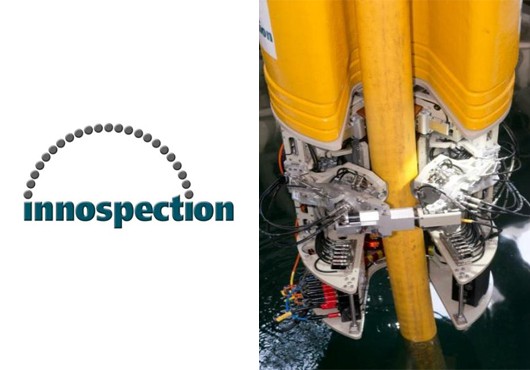
Following years of R&D and qualifications, Innospection Ltd successfully completed its first flexible riser inspection in the North Sea in February 2013.
The inspection of the flexible risers was performed using the sophisticated self-crawling inspection system named MEC-Hug, wholly developed and built by Innospection.
An Aberdeen based advanced NDT specialist and solution provider for subsea and topside inspection tasks with extensive field experience, Innospection is providing new ways of deploying advanced electromagnetic inspection technologies, particularly the SLOFEC technique, in the most challenging inspection environment.
The MEC-Hug riser inspection system was deployed from the platform and brought in position above the splash zone by rope access personnel. After the MEC- Hug inspection tool was in place, and as the name implies, the inspection tool “embraced” and moved along the risers through the splash zone to perform the inspection.
Although the inspection system could move down to -70m, the inspection task was to scan the production risers only from -30m to +5m with the focus on potential damage at the dedicated areas. The aim of the inspection was the detection of defects and wall loss in the first and second tensile armoured layer caused potentially by cracks or pitting corrosion in the single wires or multiple wire areas.
As the required scans per work scope were performed within a single shift, this inspection job has proven that the technology and its mechanical hydraulic driving mechanism allow an effective and fast scanning.
Excellent signal to noise ratio of the electromagnetic inspection technique SLOFEC enabled a high detection sensitivity setup for the identification of cracks and pitting corrosion in the tensile armoured wire layers while scanning the risers above, through and below the splash zone.
The scans demonstrated excellent signal response not only for clean wire conditions but also at a known potential area with shown indications which allowed the assessment of the wire condition. Due to the technology capability, it was additionally possible to determine the wire layer from which the indications were reflected.
The MEC-Hug inspection system is scheduled to be deployed to Australia in Q2 of 2013 for a subsea pipeline inspection job and thereafter to Equatorial Guinea for the next flexible riser inspection job in Q3 of 2013.
Press Release, June 28, 2013